
Run Your Own Local GPT Models in Microsoft Word.
Complete privacy. Zero subscription fees. Your favorite LLMs, running locally.
(Last Updated on January 2, 2026)
Table of Contents
Why is local-first a better alternative?
Unlike Microsoft Copilot in Word, which relies on cloud-based AI services, our Word Add-in is local-first. All AI processing runs on your own machine using local LLMs, so your documents never leave your device. This local GPT in Word provides stronger data privacy, offline capability, and full control over models and updates—without requiring a Microsoft 365 Copilot subscription. Additionally, because it does not depend on Microsoft’s cloud services, it continues to work even if Copilot or Microsoft services experience outages or service disruptions.
Does my document content ever leave my computer?
No. Your document content stays on your computer at all times. All text processing is performed locally using on-device language models, and no content is sent to external servers or the cloud. You can run your local GPT in Word.
Which local AI models are supported, and can I use my own models?
GPTLocalhost works with any LLM server that is compatible with the OpenAI Chat API. This means any LLM supported by those servers—including popular open-source models like LLaMA-family, Mistral, Falcon, and others—can be used with GPTLocalhost. You can also connect your own local or self-hosted models by simply pointing GPTLocalhost to your local inference endpoint.
Is this Word Add-in secure, and how does it work with Microsoft Word’s security requirements?
Yes. The add-in is designed to work fully within Microsoft Word’s security model while keeping your data local.
Microsoft Word requires all add-ins to load over a secure HTTPS connection. Our add-in complies with this requirement by using a secure, encrypted local HTTPS connection. Because the AI model runs entirely on your own machine, we use a locally generated certificate to enable this secure communication.
Your documents are processed locally and are not sent to external cloud services by default. This approach aligns with Word’s security requirements while providing a local-first, privacy-focused alternative to cloud-based solutions like Microsoft Copilot.
Can this be used offline or in air-gapped environments?
Yes. The add-in is designed to run entirely on your local machine using local LLMs. After login, it works offline and can be deployed in fully air-gapped environments, with no internet connection or data leaving your device. Your local GPT in Word simply runs locally.
Does this replace Copilot or work alongside it?
Our local Word Add-in is designed to function as a direct alternative to Microsoft Copilot in Word, offering a private, local GPT experience with your data never leaving your device.
However, it is developed to work alongside Copilot. You do not need to disable or uninstall Copilot to use our Add-in. You can choose to use our local tool for privacy-sensitive or cost-effective tasks, and still utilize Microsoft Copilot for its unique cloud-integrated features or organizational knowledge when needed.
Can I also use cloud LLMs?
Absolutely! While our primary focus is leveraging local LLMs for enhanced privacy and speed, our Word Add-in is fully capable of connecting to cloud-based LLMs as well.
We achieve this seamless integration by utilizing an LLM Proxy like LiteLLM, which acts as a unified gateway allowing our local application to communicate with various cloud providers (e.g., OpenAI, Anthropic). This hybrid approach provides a significant advantage over fixed, pricy subscription fees—like those charged by alternatives—because you benefit from a highly cost-effective, token-based usage model. You only pay for the specific resources you consume, giving you the power and flexibility of cloud LLMs with far greater control over your expenditure.
What is a local Word Add-in?
A local Word Add-in is a specific deployment option for Office Add-ins, according to Microsoft document. It is an Add-in that is designed to be sideloaded from a local file share (as opposed to being downloaded from a cloud store). This local deployment method is specifically intended for developer testing. It is used after development is complete to test the Add-in on a localhost environment before deploying it to the cloud for production.
Unlike most Word Add-ins, GPTLocalhost uses such local deployment to enable a local-only design. You can run your local GPT in Word privately in this way. By eliminating cloud deployment altogether, a local Add-in runs fully on the user’s machine and provides complete privacy.
Why do I need a local certificate to run GPTLocalhost?
Microsoft Word requires all Word Add-ins to communicate over a secure, encrypted HTTPS connection. This rule applies to both cloud-based Add-ins and local Add-ins. To use HTTPS, a security certificate is required. Because GPTLocalhost runs on the user’s local machine, it can simply use a local certificate to meet this requirement. It does not need a certificate issued by a public certificate authority.
When installing GPTLocalhost, the installer handles the creation of a self-signed local certificate automatically. But to successfully install and trust this local certificate for Microsoft Word to connect, it needs your explicit permission to modify your computer’s settings, ensuring a safe connection between Word and the Add-in.
For Mac users, please check here for details.
For Windows users, please check here for details.
How do I install GPTLocalhost on Windows?
First, download and execute the GPTLocalhost installer. Then, follow these steps to install the local Add-in in Microsoft Word.
- Click “My Add-ins”.
- Under Developer Add-ins, add GPTLocalhost.
- As per Microsoft documentation, this manual installation is necessary for all local Word Add-ins because Developer Add-ins are loaded directly from your computer and run locally without a cloud connection.
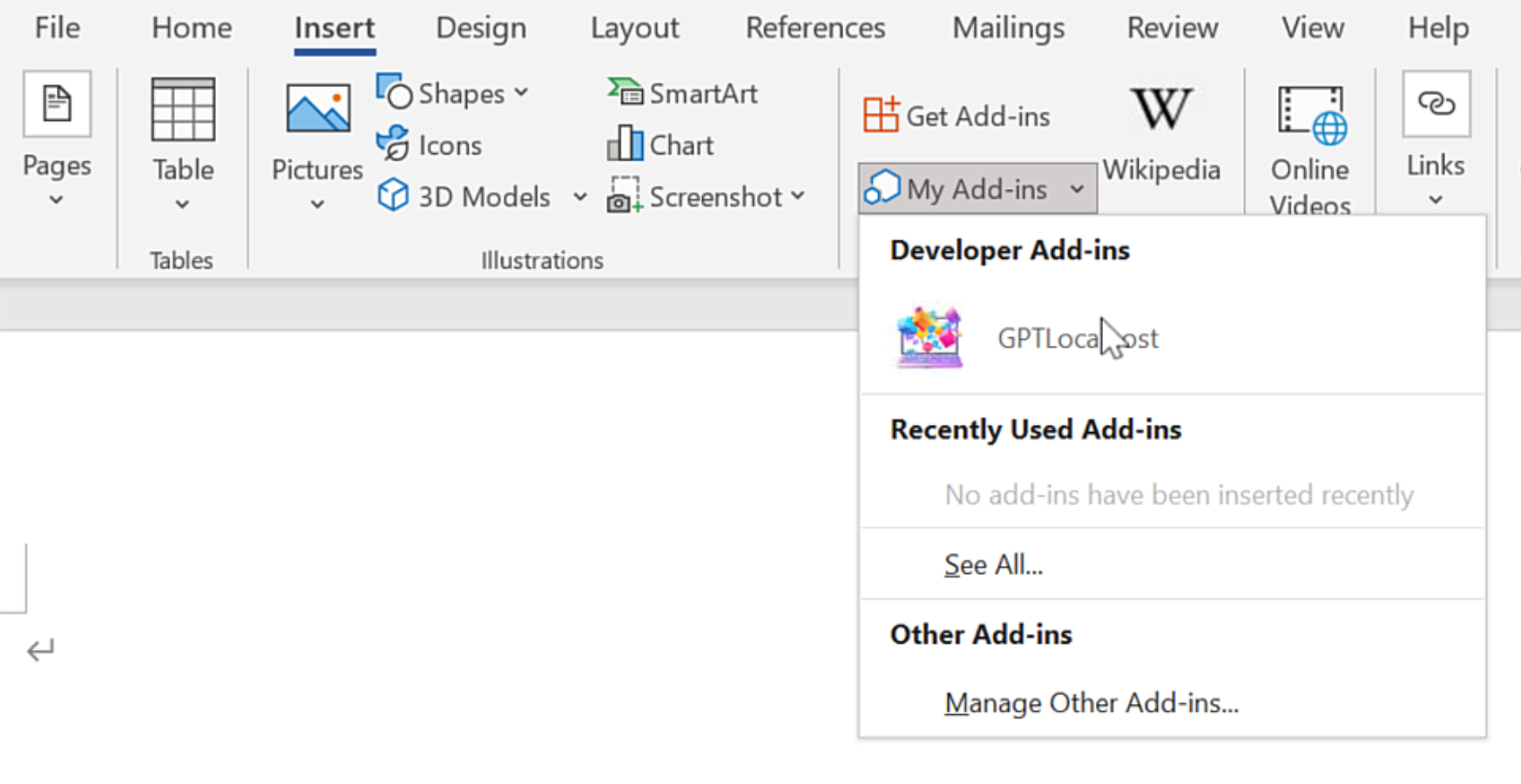
- Behind the scene, the GPTLocalhost installer automatically sets up all the necessary components for running the local Add-in. This includes creating a network share for sideloading and installing a local certificate for HTTPS, which follows Microsoft specification and allows Microsoft Word to securely access the local Word Add-in.
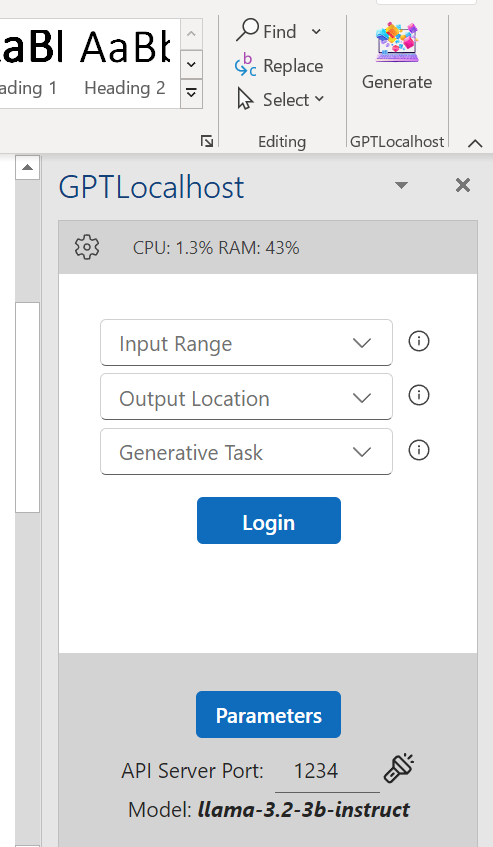
- With setup complete, you can now directly and locally connect your favorite LLM server within Microsoft Word.
How do I install GPTLocalhost on Mac?
Please download and run the GPTLocalhost installer.
During the installation process, follow the steps below to successfully install both the local Word Add-in and a self-signed certificate for https. A detailed demo video is available for guidance.
- Click “Continue” to grant your permission and install the necessary local self-signed certificate. This action enables secure HTTPS communication for the local Word Add-in, as required by Microsoft’s security specifications.
- In the next window, enter your MacOS password to update your Keychain and add the new certificate.
- For details, click “Explain” to access Microsoft’s developer resources.

- When starting the GPTLocalhost Word Add-in for the very first time, you need to establish a secure connection to your local environment. This requires you to configure and trust the new certificate.
- To proceed with the security configuration, please click “Show Certificate” in the following screen.

- Click Always trust “127.0.0.1” when connecting to “localhost” in the following screen.

- After the certificate update, click “Restart” in the Microsoft Word task pane.
- The local Word Add-in will not run the first time because the new certificate has not yet been trusted. Once the certificate is trusted and the Add-in is enabled, GPTLocalhost will run smoothly without requiring any further configuration.

- You can now use the GPTLocalhost Add-in in Microsoft Word.

- Please remember to keep the GPTLocalhost Server running. It acts as a web server, providing the web pages of the local Add-in to Word, along with other enhanced functions.
